
By Manuel M. Melgoza (October 19, 2025)
Is it wrong for Christ’s disciples to judge human races, nationalities and cultures? Aren’t they of equal intrinsic value? Should we compare them and, upon what criteria?
Confusion and chaos have permeated public discussion on these topics, largely because we fail to distinguish and properly apply these terms and the standards by which we should assess to reach valid conclusions. Consider the following illustration.
El Domingo
In my childhood years, Mexico had a tradition called “El Domingo.” Literally translated, El Domingo means “the Sunday.” The literal translation inadequately describes the practice. With minor variations, this is the way I remember it from my extended family’s experience.
Every Sunday, all children of each family were permitted and encouraged to approach adult relatives – parents, uncles, aunts, grandparents, godparents, etc. – and request their Domingo. If requested, the relative would give the child money; an amount of the adult’s choosing. I typically asked for my Domingo from my grandparents and from aunts and uncles who lived near enough to ask. My grandmother invariably gave me a 50-cent piece (un toston). My grandfather habitually, and reluctantly, gave me a 20-cent piece (un veinte). He was reputedly stingier than my other relatives. Uncle Abraham was the most generous. He invariably gave me a silvery coin worth un peso (100 Mexican cents). When I happened to encounter a padrino – a “godfather” or an adult who sponsored me in a baptism, confirmation, or First Communion ritual – he too would give me one peso.
To get one’s Domingo, the only precondition was – one had to ask. That could prove disadvantageous because, if you were too shy to ask, the relative had no obligation to give. The advantage to receivers, apart from its obvious material value, was that you didn’t have to earn El Domingo. You could be naughty that whole week, or good. Self-merit had no bearing on your entitlement to El Domingo, or on the amount you got. You couldn’t be disqualified from it if you “didn’t deserve it.” The giving adults didn’t look upon it as something earned either. They gave it to each requestor who was considered familia. The child just had to ask. The recipient could use it in any way he or she pleased.
El Domingo was based, in its essence, unmerited favor. El Domingo was a tradition, part of the Mexican culture, although it appears to have diminished almost to non-existence today. It was not rooted or dependent upon race or nationality. Culture is “the totality of socially transmitted behavior patterns, arts, beliefs, institutions, and all other products of human work and thought characteristics of a community or population.”[1]
By definition, “cultures” change based on the temporal variations in the patterns of behavior of the cultures’ individual members. An element of choice is inherent in culture.
Nationality
Likewise, nationality is temporal, subject to change. I was born a Mexican national. When I transitioned by applying for U.S. citizenship as an adult, I surrendered my Mexican citizenship, and gave an oath of loyalty to the U.S.A., thus changing my nationality. My parents became U.S. citizens in a similar way, but elected to accept Mexico’s offer of “dual citizenship.” My youngest sibling was the only family member born in the U.S. She did not need to apply for U.S. citizenship. Indeed, U.S.A. is her nationality. Neither Mexico nor the U.S.A. consider her a Mexican national. Also, nationality is not determined by race. Actually, both Mexico and the U.S.A. have populations comprised of various races.
Race
Race, by comparison, is biologically unchangeable. It cannot be changed by individual or group decision. Compare, for example, the native black populations in the U.S., with the native populations of African countries. The populations may share common races, but their cultures and nationalities vary dramatically. One obvious cultural difference is language.
All human beings are created by God as equal in nature and value. This is a self-evident truth, inscribed by America’s founders in the Declaration of Independence. There is no valid basis upon which to judge one race as superior or inferior to other races.
However, that does not mean we cannot make comparisons and judgments based on culture and nationality. Indeed, Biblical scripture demands we do so, and reject/discourage cultural practices that contradict God’s commands.
How Should We Decide?
How can we Christians validly evaluate, “judge,” and choose which cultural characteristics to practice and promote, and which to discourage or reject? True believers will base those comparisons and conclusions on whether the cultural practices align or depart from Biblical teachings.
El Domingo is an apt illustration. For those of us who have received similar rewards, it’s not difficult to grasp this concept of unmerited or undeserved favor. This parallels what the Lord our God offers us – unmerited favor in astronomical proportions compared to El Domingo.
Is there any among us who does not sin, and thereby falls short of the perfection that (except for the forgiveness available through Jesus Christ) is required to stand in the presence of God Almighty? Do we understand the Bible’s expressions that nothing we can do through our own efforts is sufficient to permanently cleanse us of this persistent sin? Only Jesus Christ’s sacrificial death on the cross can atone for our past, present, and future sins.
God’s Scriptures say we are saved to eternal life with God in Heaven by God’s grace [unmerited favor] through our faith in Christ Jesus. And, obedience to God comes from faith. Thus, faith in Him enhances our ability to obey Him. All we need to do is place our trusting faith (believe) in Him.
In the weekly El Domingo tradition, I trusted that if I approached and asked an adult relative for my Domingo on a Sunday, he or she would be faithful to give me some amount of money. God is infinitely more faithful to keep His promises than any human. All we need do is sincerely ask Him to be our Lord and Savior – to accept Him for what He claims to be. Then, like El Domingo, we receive that promised favor (God’s grace) that we do not deserve and could never try hard enough to earn. Some rewards for asking are immediate (peace of mind, joy, etc.), and some are prospective (eternal treasure of Heaven). Nothing done in the past could disqualify us from this unmerited favor, so long as we ask, while there is yet time.
As Christians, we must NOT assess the value of cultural traits on non-biblical concepts. Yet, many Americans, including professing Christians, seem to have done just that in the last half-century or so. They have, knowingly or unwittingly, accepted a concept called “Cultural Relativism.”
Cultural Relativism is the principle of regarding the beliefs, values, and practices of a culture from the viewpoint of that culture itself. Cultural Relativism refers to the ability to understand a culture on its own terms and consequently not make judgments based on the standards of one’s own culture. From the cultural relativist perspective, no culture is superior to another when comparing their systems of morality, law, politics, etc.[2]
Cultural relativism is also based on the idea that there is no absolute standard of good or evil. Thus, every decision and judgment of what is right or wrong is individually decided in each society. This claim comes with several corollaries; namely, that different societies have different moral codes, there is no objective standard to judge how good or bad these moral codes are. A related concept, Moral relativism, claims that what is customary in a culture is absolutely right in that culture. Cultural relativism asserts that there is no real way to measure right or wrong. (Ibid)
Cultural relativism is contrary to Biblical scripture, and to ethnocentrism, which encourages people to look at the world from the perspective of their own culture. Ethnocentrism is also at odds with Scripture.
In practice, cultural relativists discourage the devaluing of cultural practices that are unfamiliar to other cultures, such as sacrificial killing.[3] Combined with Moral Relativism, no standards of conduct would apply to cultural relativists. They are free from judgment for any practices they adopt.
Conclusion
Arguably, those who believe in, and practice cultural relativism pose a threat to the continuing survival of peaceful, ordered societies, do they not?
Which cultures should Christians respect, promote, or discourage? Should we embrace “multi-culturalism” without limits? That would contravene God’s Word. I opine that we not advance unbridled multi-culturalism. Instead, we should promote what I would refer to as a “Jesus Culture,” a term also cleverly adopted by one Christian church movement as its name.
Distancing ourselves from multi-culturalism does not mean that we should reject or devalue an entire culture. It simply means that we should choose which cultural practices we should align ourselves with and which we should discourage, based on Biblical criteria, not Cultural Relativism. I cherish many cultural traits common to my Mexican heritage. But, speaking frankly, there are some which I consciously disassociate from. Similarly, there are cultural traits I have found attractive and adopted as my own within the “American” culture I adopted since emigrating from Mexico. Whether some are more valuable than others should depend not on my subjective opinion, however, but rather whether they are consistent with God’s teachings.
[1] William Morris, The American Heritage Dictionary of the English Language (1971)
[2] Charlotte Nickerson, “Cultural Relativism: Definition & Examples,” Simply Psychology (September 29, 2023).
[3] Finger cutting of the Dani tribe: Women of the Dani tribe in Indonesia have a unique way of dealing with grief. When they lose a loved one, the top joint of a woman’s finger will be amputated, a practice known as ikipalin. String will be tightly tied around the finger until it goes numb and then a family member will cut off the top of the finger. The wound is then burnt to stop the bleeding and prevent infection. The process is to symbolize the pain suffered after the loss of a loved one and to keep the deceased person’s spirit away – missing fingers represent the loss felt by missing family members.
Baby tossing in India: In parts of India, a ritual that involves throwing babies off the side of temples. Infants under the age of two will be shaken by a priest and then dropped between 30 and 50 feet. The ritual is followed by both Hindus and Muslims in rural areas of the states of Maharashtra and Karnataka, with around two hundred families taking part. The ritual has been around for over seven hundred years. In the early years, unwell children were dropped down without protection, and it was believed the almighty would miraculously save them by creating a hammock out of air. Today, children are thrown onto a sheet below that’s held by a group of men. It’s thought to bring good luck and a long life for the child.
In Kyrgyzstan, the kidnapping of a girl is legal. This custom is followed by Roman gypsies. Bride kidnapping or marriage by abduction has been practiced across the world throughout history. Kidnapping a bride also means that you have won her heart and got the right to marry her. The ritual is all about a man kidnapping the girl with the help of his friends and asking for parent’s consent later. Men are also allowed to keep the girl as a hostage for 4-5 days. This custom forces the girl to accept her kidnapper. If she refuses, she can never be considered for marriage again. https://stillunfold.com/art-culture/10-weird-cultures-from-around-the-world-that-are-hard-to-believe
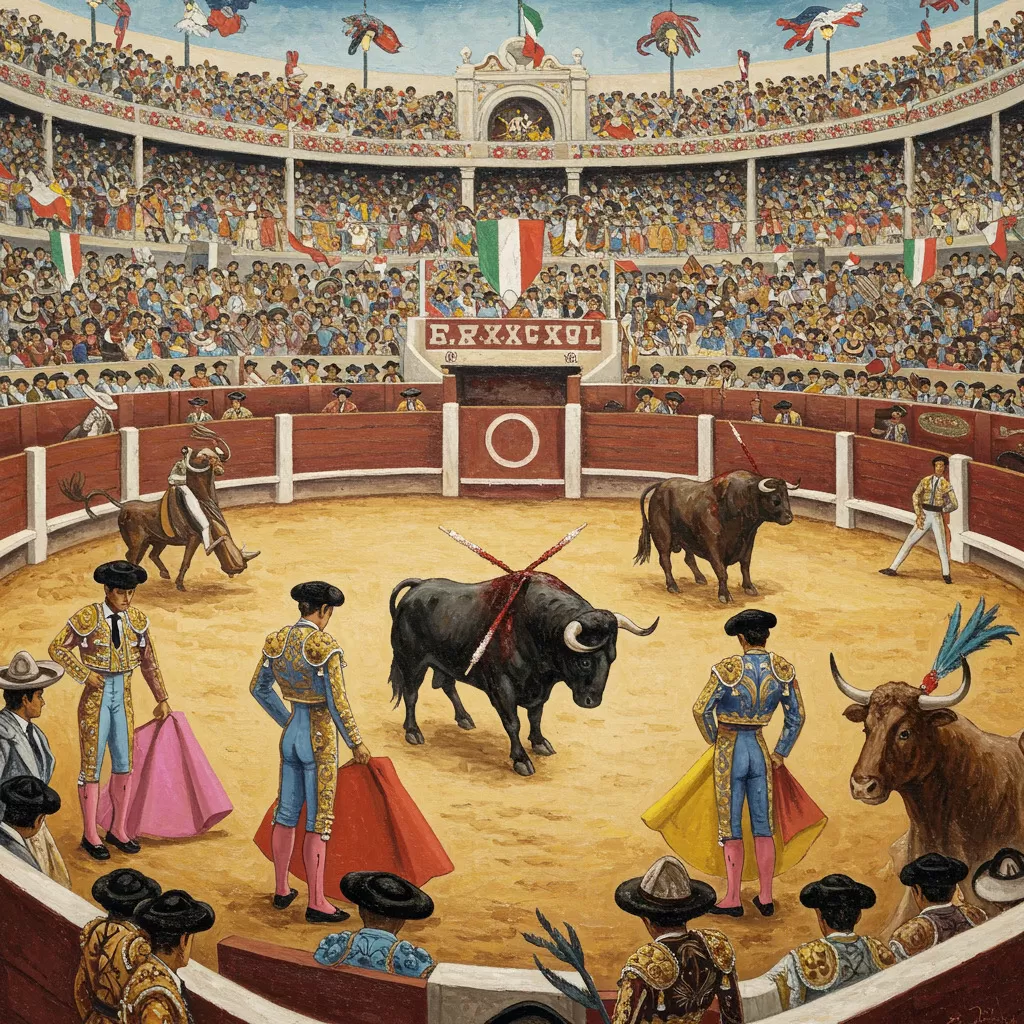
Illustration from https://www.mexicohistorico.com/paginas/The-History-of-Bullfighting-in-Mexico.html
 CHAPTERS